

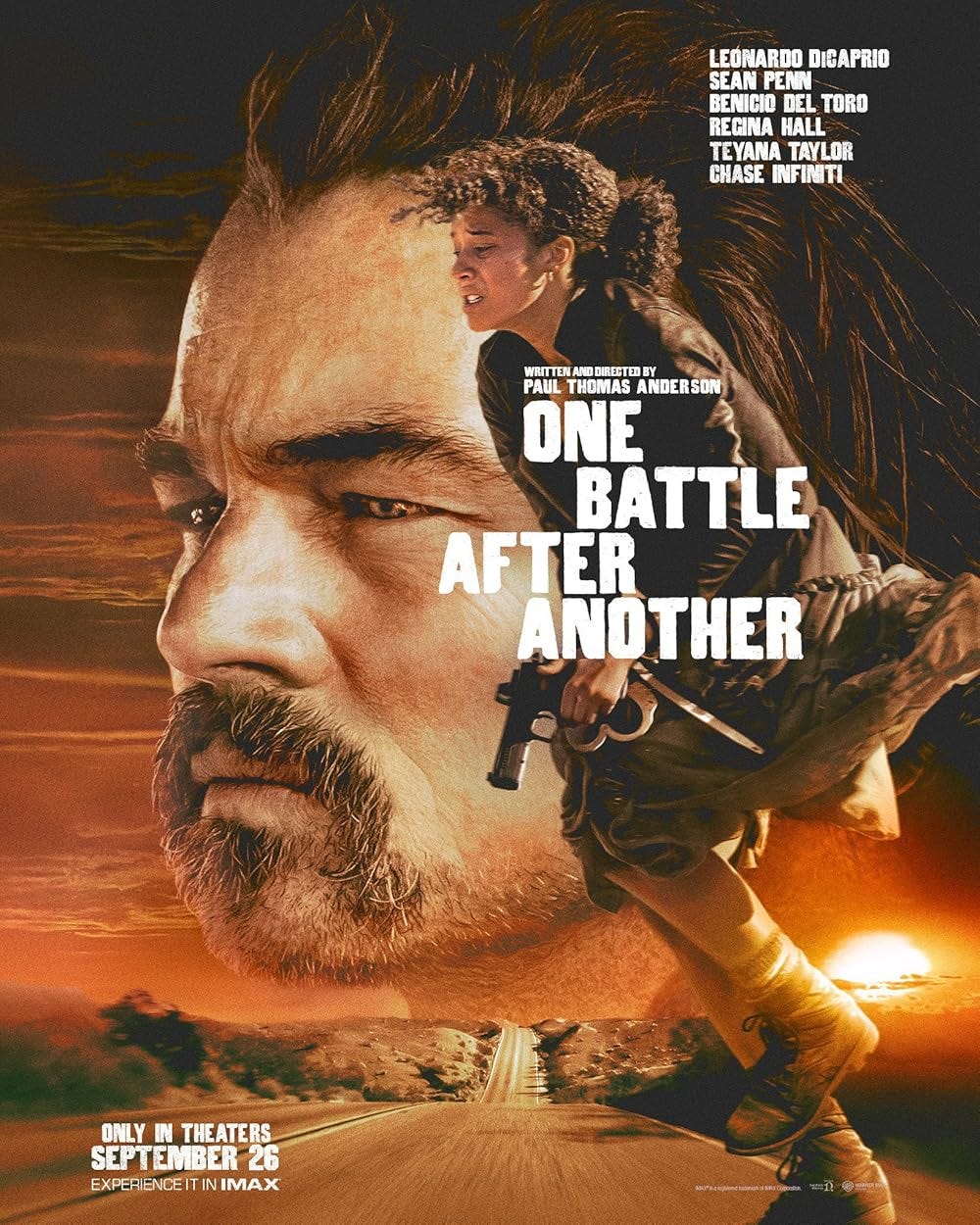
The 98th Academy Awards are tonight and I plan on watching. Personally, I’m rooting for Sinners, the Ryan Coogler vampire-blues-horror film that is so much more than the sum of its genres. The film received 16 nominations, more than any other film in the history of the awards. But the buzz leading into award season has been obsessively focused on another film, Paul Thomas Anderson’s One Battle After Another (nominated for 13 Academy Awards), starring Leonardo DiCaprio, Teyana Taylor, and newcomer Chase Infiniti. Before the film had even been released, my husband was reading comments out loud to me from Reddit threads about how it was the best film ever made.
The best film ever made? The early buzz soon turned into a deluge of superlative, fawning reviews once the film was released. The New York Times alone has dedicated more than a dozen articles, op-eds, and podcasts to the film. Critics seemed to be dazzled by the prescience of the film’s story, which at times is like a mirror held up to our current reality—projecting images eerily similar to the ones broadcast from Minneapolis just weeks ago. (And while Anderson deserves credit for highlighting the horrors of the American immigration system, so too do journalists like Maria Hinojosa who have reported on this topic for decades with little fanfare.)
SPOILERS AHEAD . . .
OBAA is ostensibly about a group of radical activists called the French 75 who use violence to implement their vision of justice, which includes bombing government buildings, robbing banks, infiltrating immigrant detention centers and setting inmates free. Interracial collaboration and love are a hallmark of the group, and Perfidia Beverly Hills (Teyana Taylor) and Pat Calhoun (Leonardo DiCaprio) become its poster children. She’s black and he’s white. Naturally, they fall in love and have a child together. But Perfidia, dogged by postpartum blues, prioritizes her commitment to the movement over her newborn daughter. Except when an illicit entanglement with Colonel Steven J. Lockjaw, a commanding officer at an immigrant detention center, catches up to her, she rats out her comrades in arms. One by one, the members of French 75 are arrested or murdered, while Perfidia slips away to Mexico and Pat is forced into hiding with their daughter under the assumed identities of Bob and Willa Ferguson.
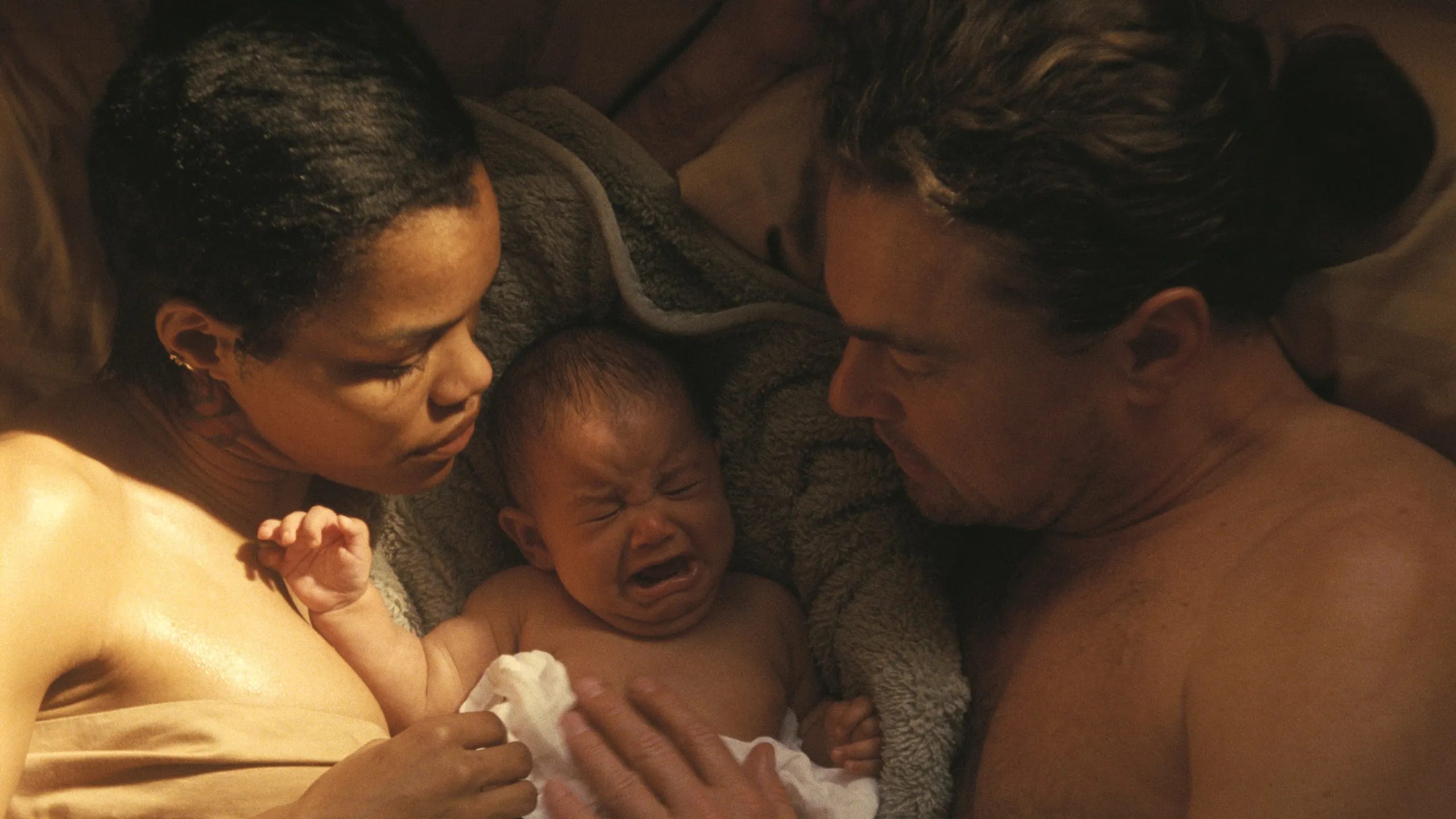
A few critics, like Ellen E Jones in The Guardian and Daphne A. Brooks for the New York Times, have taken issue with the way the film both sexualizes and villainizes Perfidia as a black woman, a character who interestingly is not racialized in the source material, Thomas Pynchon’s novel Vineland. The criticism is warranted. I felt a certain discomfort watching the camera zoom in on Perfidia’s ample behind as Lockjaw ogles her through binoculars. She is a sex object, bad mother, and traitor to the cause, which treads on old racist tropes about black women. That’s a lot to dump on one character. Not all depictions of people of color can be expected to follow the straight and narrow, but it’s understandable why many of us are sensitive to negative characterizations because mainstream media so often defaults to patronizing, demonizing, and victimizing people of color. The problem, as Viet Thanh Nguyen has termed it, is a lack of narrative plenitude.
What really interests me about OBAA—and what I can’t stop thinking about—is the mixed race woman at the center of the story: Willa, Perfidia and Bob’s daughter, played by Chase Infiniti. As many critics have noted, the film is not so much about a leftist guerrilla movement as it is the story of a father and daughter and the connection between them that goes deeper than blood.
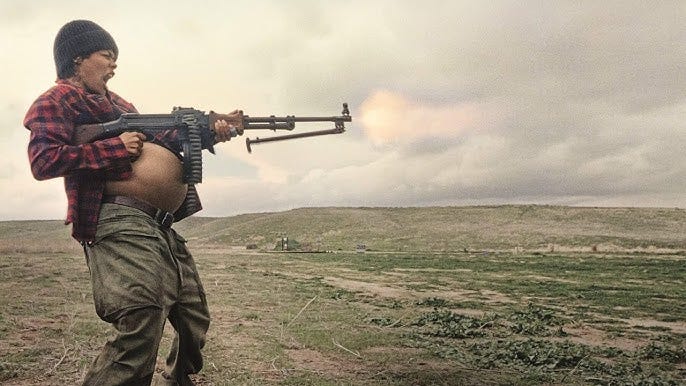
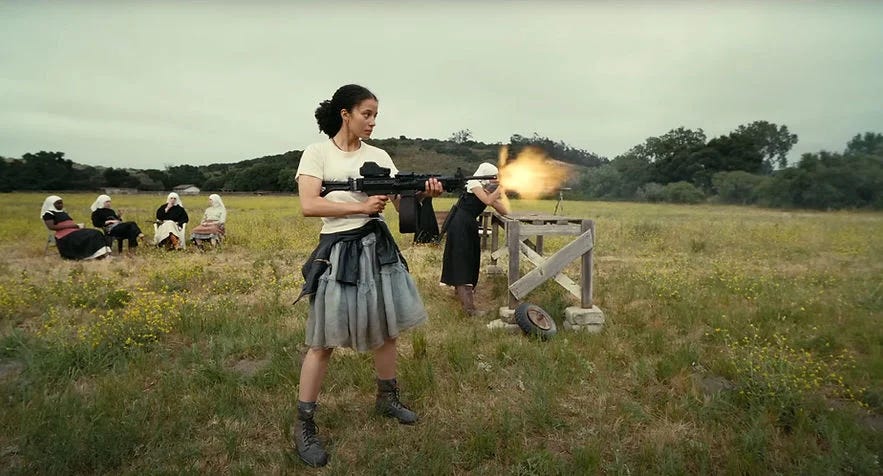
Even if you haven’t seen OBAA, you’ve probably seen a trailer or ad for it with the indelible image of Perfidia wielding a machine gun while pregnant, belly out. The film jumps to a decade and a half later, when Willa, now a young woman, is suddenly thrust into the unresolved mess precipitated by her parents’ heyday in the French 75. On the run from Lockjaw, Willa takes refuge at a convent run by former members of the resistance. With a violent confrontation seemingly imminent, the sisters send her into a field to practice shooting rounds with a machine gun. The visual call back is unmistakable. Like mother, like daughter.
It’s this link to her mother, someone she never knew, on which the entire plot hinges. In truth, Willa is not Bob Ferguson’s biological daughter, but the product of Perfidia’s psycho-sexual encounter with Colonel Lockjaw. She is evidence of intimate relations between a black woman and a white man—a historic no-no in American race relations—and an existential problem for Lockjaw, who seeks to join a thinly veiled white nationalist group called the Christmas Adventurers Club. The question of whether he may have fathered a mixed race child is a big fucking black mark that looms over his resume and could potentially bar him from the thing he desperately wants most: recognition from the white elite. To be designated a so-called “superior man.”
From a wood-paneled conference room deep inside an extensive, underground facility, the Christmas Adventurers review Lockjaw’s background check:
Bill: Tim, I’m going to get right to it. There’s an unconfirmed report that Colonel Stephen J. Lockjaw is the father of a mixed race child.
Tim: Which mix?
Bill: There’s no real easy way to say this, but yeah. It’s black.
Notice how Bill subtly dehumanizes Willa by referring to her as “it,” rather than as “she” or “the child.” Lockjaw and the Christmas Adventurers come to the same conclusion separately. All proof of Lockjaw’s racial transgression has to be destroyed. Willa must be exterminated.
A chill came over me as I sat in the darkened movie theater and realized what was about to go down. The threat against Willa’s life felt quite personal, like my worst fears realized. As a school kid learning about the Holocaust, it did not escape my attention that in addition to killing six million Jews, the Nazis also sent Roma, disabled, and mixed race people to the death camps. Maybe you will think I’m being overly dramatic, but I have always wondered if it could have been me shoved onto one of those windowless freight trains—the unclean, impure half-breed, a blemish on the white race that must be erased.

Some have speculated on Anderson’s inspiration, calling OBAA his “most personal” film. This is largely due to the fact that Anderson’s longtime partner is actress, comedian, and former SNL cast member Maya Rudolph, whose mixed race identity has lent itself to impressions of everyone from Kamala Harris to Rachel Dolezal. Together they have three daughters and a son, which means Anderson knows a little something about being the father of a mixed race daughter just like his protagonist, Bob Ferguson.
I have sometimes found the things that parents say about their mixed race children grating: they say their child is confused and doesn’t know who they are; they worry their child’s fair complexion will encourage them to be racist towards them. The fact that Anderson could pull off a movie like this without falling prey to these pitfalls suggests something about his connection to his children and his wife, and the acuteness of his observations of their lived experiences.
The turning point in Willa’s escape comes when Avanti (Eric Schweig), the bounty hunter Lockjaw has paid to take Willa to the 1776 outpost where their crew will “bag and tag” her, has a change of heart. Though he has very little screen time, every appearance or mention of Avanti elicits a barrage of racial epithets. One of the Christmas Adventurers says he can’t be trusted because he’s not a native son; he passes himself off as “half Mexican, but he’s actually part Comanche or Eskimo.” When Avanti brings Willa in to 1776, the man out front addresses him as “wagon burner” and “hey, red.” He’s also just heard Lockjaw call Willa a “fucking mutt” and try to pass her off as a “murder suspect wetback half-breed involved narco cartels. Nobody that will be missed.” What a thing to say about your biological child.
It seems that a lifetime of swallowing the unvarnished racism spewed at him finally snaps something in Avanti. The bad guy becomes a good guy. (A reversal of the stereotype of the flip-flopping mixed race person who can’t be relied on!) He unlocks Willa’s handcuffs, letting her escape, and proceeds to blow up the rest of the 1776 crew with a shotgun, sacrificing himself in the process. With the spray of several bullets, Willa goes from an inconvenient “body” that needs to be disposed of back to a 16-year-old girl running for her life. Was this scene intended as an act of solidarity by one mixed race person for another? I like to think so.
All hype aside, the themes in OBAA resonated with me on a level that most films do not. It was gratifying to watch a mixed race character rendered on the big screen with such humanity and care, and to see her brought to life by mixed race actor Chase Infiniti, who gives a powerful performance. In another era, Infiniti would have been lucky to get a role as meaty as this one. The same could go for Hailee Steinfeld who plays a mixed race character in Sinners. Unless they chose to pass for white or were pressured into it like actresses of yore Merle Oberon and Vivien Leigh, parts for multiracial actors were slim to nonexistent. The Hays Code with its ban on interracial relationships essentially prohibited it.
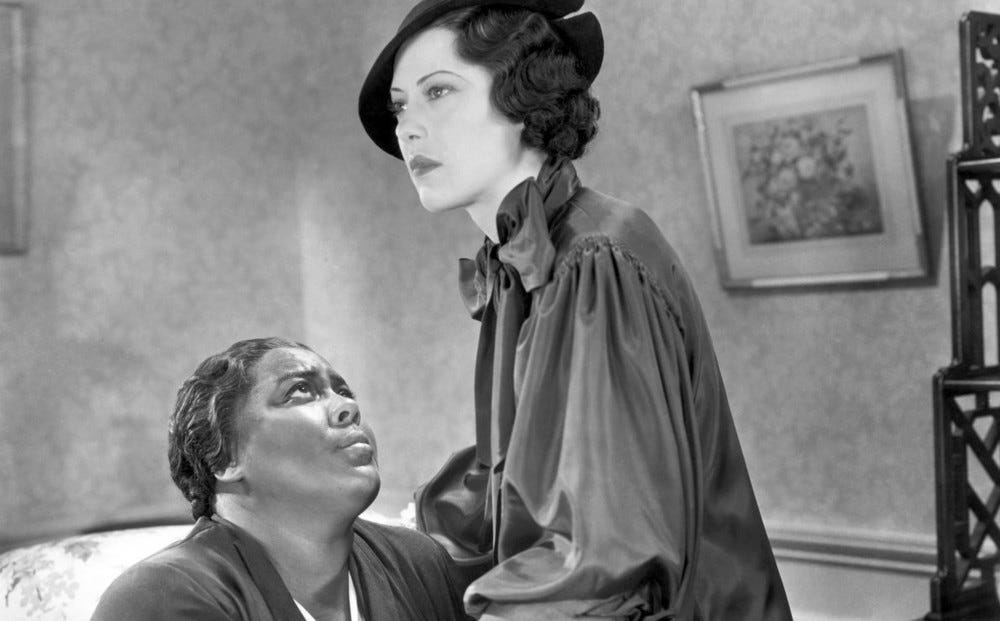
By comparison, the Hollywood career of Fredi Washington, an actress born at the turn of the twentieth century, peaked in 1934’s Imitation of Life as Peola Johnson, a light-skinned black woman who is tormented by her desire to pass as white. In one of her most memorable scenes, she stares into a mirror and declares to her black mother, “I want to be white, like I look.” I couldn’t help but scoff when I heard her utter that phrase. What a ridiculous sequence of words to feed into a mixed person’s mouth.
More than 90 years apart, the racial anxieties that pulse through each of these films remain similarly invested in fears of the mixed race body. One Battle After Another is a vast improvement from the hackneyed passing narrative of Imitation of Life. But I’m still holding out for a film where the mixed race woman is neither hunted, shamed, nor exoticized. She simply gets to be herself.
Thanks for this Katie! I didn’t know about Maya Rudolph and that adds a lot. I was wowed by the daring and structure and timing of the film and am stunned by the way it is misunderstood and misrepresented. It’s devious work of art that deserves the awards it got tonight. I wrote about it, too!
Katie, there’s a more clinical term for Avanti’s behavior: Moral Injury. When a person feels complicit or guilty for grave moral offenses, it will eventually break them, and many explode in ways that attempt some kind of redemption. Usually involving suicide. [check out @Michael Valdovinos ] The guy who blew himself up in a Tesla in Vegas was suffering from moral injury. Avanti was a poster boy for this condition. Just one of so many “caricature” portraits in this film that are truer than true.