

Read to the end for details about my book giveaway for AANHPI Heritage Month!
It’s a peculiar experience to watch something you have known about intimately for a long time (cough, the existence of mixed race Asians…) suddenly make it into the public eye in a big way. As of late, the hapa girlies (and guys) have been undergoing something of a renaissance. Or maybe it’s just the chickens finally coming home to roost; it’s been nearly 60 years since the landmark Supreme Court case Loving v. Virginia declared laws banning interracial marriage unconstitutional.
Here’s how I knew us halfies had finally hit the mainstream. My husband is a culture sponge who is usually glued to his phone. One night, instead of laughing at some obscure joke on a sports subreddit, I found him watching a video of Alysa Liu, the U.S. Olympic skater, explaining how to pronounce her name correctly. The 20-year-old with the raccoon dye-job and frenulum piercing who won gold in the women’s singles at the 2026 Milano Cortino Winter Olympics with effortless style. I’m sure you know exactly who I’m talking about.
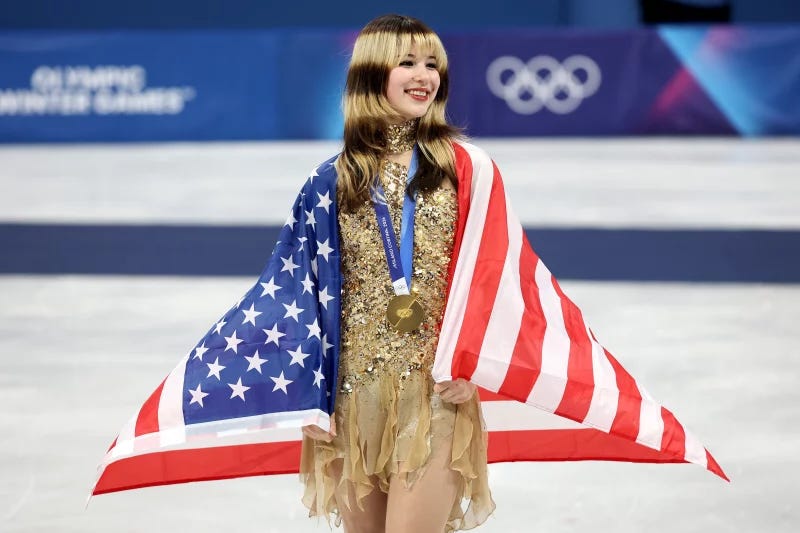
Since winning the gold in a stunning performance—“I felt like I was floating”—Alysa’s been popping up everywhere, in X and reddit threads explaining how the image of her holding up her medal and gritting her teeth pays homage to Oakland rapper Mac Dre, in TikToks of young women showing off their Alysa Liu-inspired hairstyles, as an animated avatar on boxes of Lucky Charms (her favorite cereal) for St. Patrick’s Day, and most recently on the red carpet at The Met Gala.
Her latest cameo, the one that’s got the Asian internet all abuzz, was in pop jazz singer-songwriter Laufey’s 1960s-themed music video for Madwoman. I was away on vacation when it dropped but even so, my Instagram feed instantly filled up with posts about the video featuring not one, not two, but seven mixed Asian celebrities: Laufey, Alysa Liu, Lola Tung (star of The Summer I Turned Pretty), Megan Skindiel (member of the girl group Katseye), and Hudson Williams (of steamy Heated Rivalry fame) with brief appearances by actresses Havana Rose Liu and Chase Sui Wonders. The one thing they all have in common is mixed Asian and European ancestry, which has led the internet to dub them “the avengers of mixed Asians,” representatives sent from “the Republic of Wasia,” and likened to Thanos’ gathering of the Infinity Stones from across the Multiverse.
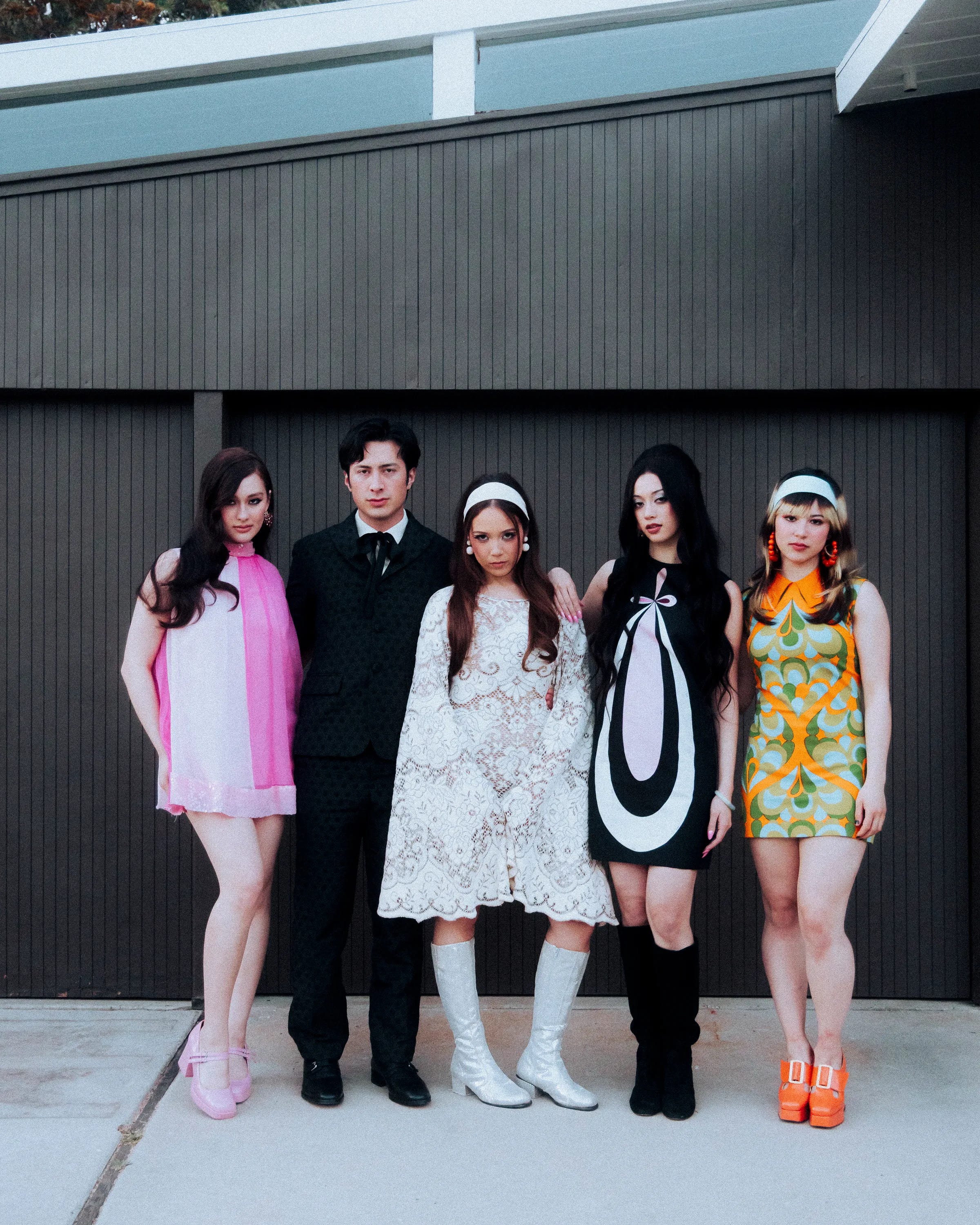
I have to admit, it’s a rare thing to see so many mixed Asian people intentionally gathered in one piece of media and to see them playing themselves or at least 1960s versions of themselves. What I mean is that their ambiguous appearance has not been exploited in typical Hollywood fashion, forcing them into a confined racial box of either representing someone fully Asian or someone fully white, roles that would erase their mixed identities in the process. Instead, their collective presence reinforces each other’s identities, making them legible, in a sense giving themselves permission to appear as they are: just mixed.
The idea for the video came when Laufey (loosely pronounced LAY-vay) was hanging out with several mixed Asian friends. She pondered out loud what it would be like for all of them to be featured in one of her music videos. In another telling of how the concept emerged, Laufey explained that she’s often mistaken for other mixed Asian celebs and tagged as them on social media (a familiar case of the wrong Asian). Filling her music video with other hapas is a play on this common annoyance and a way to keep people guessing. Who’s who? With some help from Gold House, a non-profit primarily focused on advancing the representation and recognition of people of Asian and Pacific Islander descent, plans for a music video soon got under way.
If you’ve never listened to Laufey’s music before, you may be in for a surprise. Even music critics have struggled to characterize her sound. I’d call it nostalgic bossanova pop. Think: tunes that sound like they came straight off a 1960s Hollywood lounge soundtrack but modernized with the Gen-Z slang and outlook. Some have called Laufey the woman who is single-handedly saving jazz, while others have emphatically pronounced her music is not jazz at all.
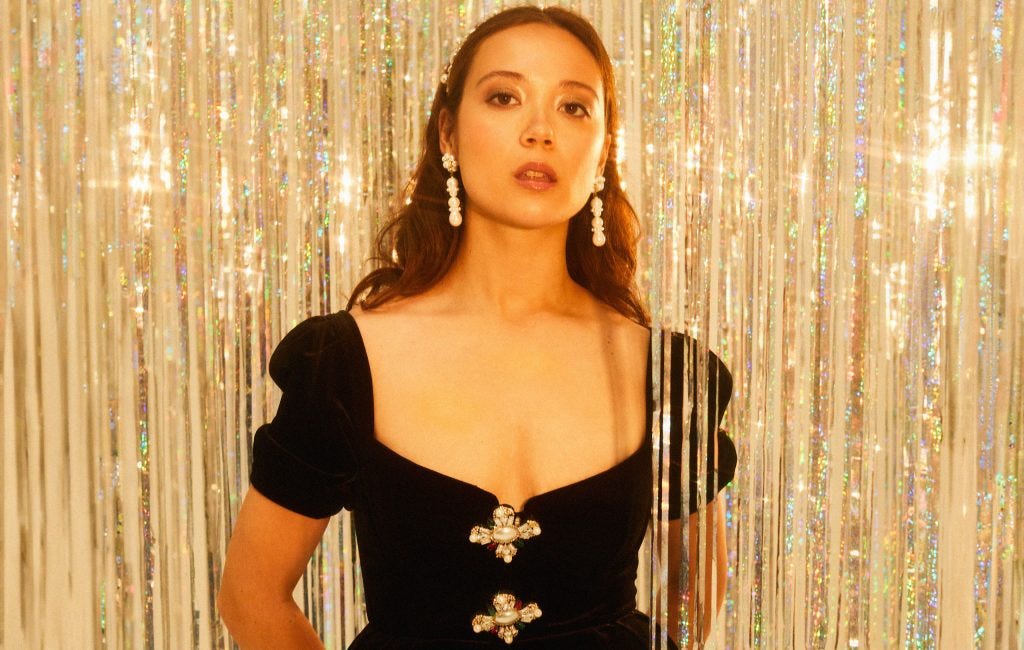
“At the end of the day, what are genres?” Laufey told a reporter at Elle magazine. “I’ve spent my whole life trying to fit into some sort of box. Am I a classical musician, a jazz musician? Am I Icelandic? Am I Chinese? Am I American? I’ve never been able to fit into a box. So I’m trying to distance myself from that. I think that’s quite old-fashioned.” There’s that box again—and the inherent conflict of being mixed. Too much and never enough. Neither one thing nor the other. The music video for Madwoman is Laufey’s attempt at embracing this inbetweenness with a group of people who know it well. There is validation and safety in numbers, in saying, I’m not the only one.
In the video, we see Laufey living what appears to be an outwardly glamorous life at a mid-century modern LA home. In truth, she’s trapped in this idyllic setting and going through the motions of a toxic, love-hate relationship with Hudson Williams’ character. Her mixed Asian besties, dressed in the bright pink and orange hues reminiscent of the Scooby Doo gang, play mahjong poolside, gawk at a shirtless Hudson, and show up in a pinch whenever some groovy dance choreography is called for. It’s a silly, cotton candy kitsch kind of music video. A little bit Mad Men, a little bit Don’t Worry Darling, a little bit Stepford Wives. Nothing we haven’t seen before.
According to The Hollywood Reporter, the 1960s backdrop was thought up by Laufey’s twin sister, Junia, to put “a twist on all-American mid-century iconography with a cast we don’t normally see in that environment.” It’s a nice idea. I’m neither a Laufey fan, nor was I especially familiar with most of the people in the video (aside from Alysa Liu and Hudson Williams), but I did feel a rush of excitement seeing my fellow hapas represented in this way. The behind-the-scenes footage of the group goofing off and generally embracing their mixedness together was fun to watch.
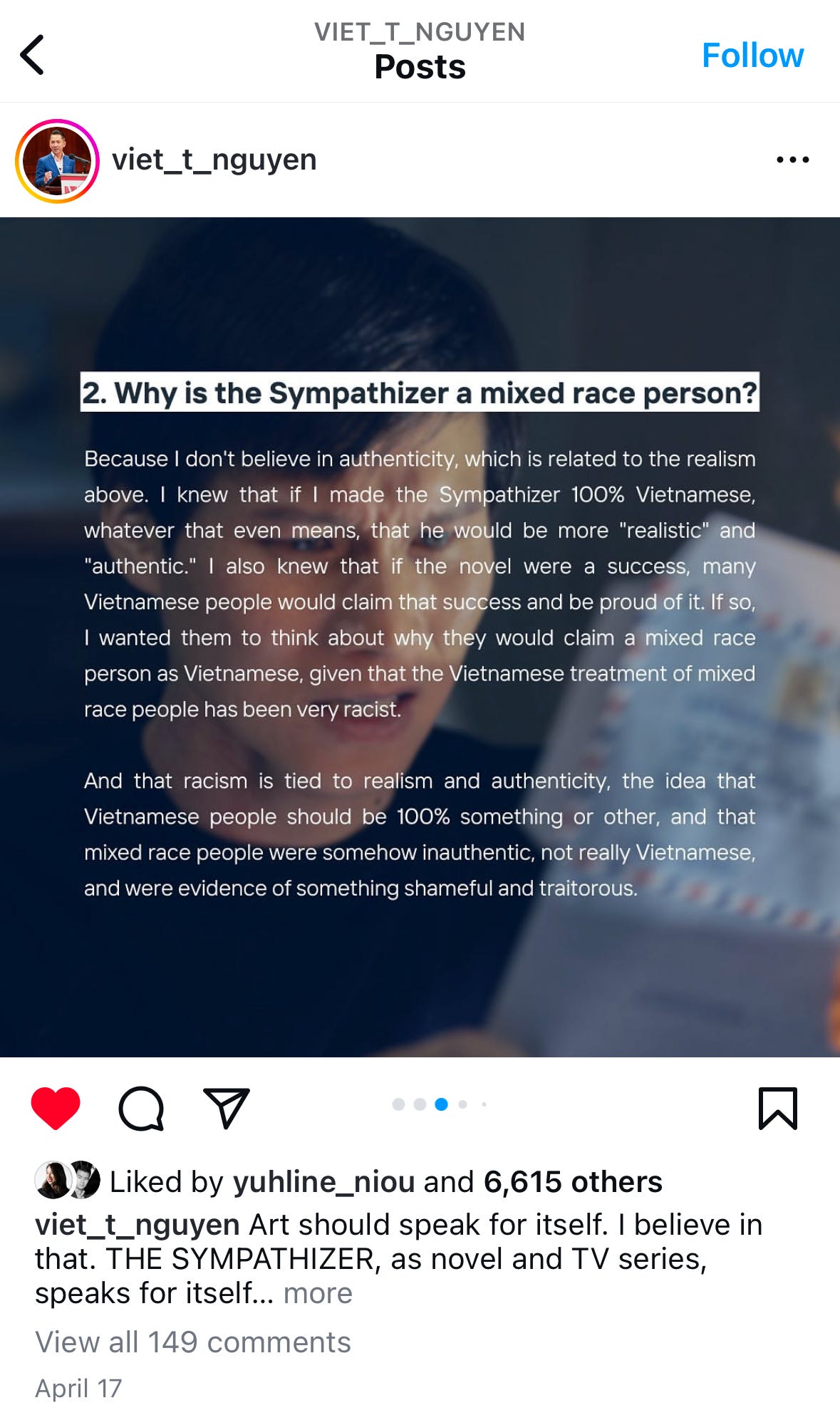
It’s also gratifying to know that an AAPI organization like Gold House helped bring the project to fruition and is actively elevating and celebrating mixed Asian people. This might seem like an obvious thing to do, but it hasn’t always been the case. There was a simmering controversy over the fact that Henry Golding, an actor of English and Malaysian descent, was cast as the male lead in Crazy Rich Asians (2018) instead of a “fully Asian” actor. This happened again when Viet Thanh Nguyen’s novel The Sympathizer was adapted into a limited series on HBO. The protagonist of the book and the show is mixed, part Vietnamese, part European. Even though the actor playing him was not mixed (which I have a lot of feelings about), Nguyen apparently received enough criticism to warrant an Instagram post (that is no longer public) defending his decision to make the character mixed.
I’ve been on the receiving end of this strain of resentment from other Asians. I’ve had friends tell me that if they didn’t know me, they wouldn’t consider or count me as Asian; I’ve had to politely nod through a seemingly endless commentary on my facial features typically made by people who have just met me; and I’ve been questioned about why I even care about being Asian since I obviously don’t look the part. And yet somehow I’m the one who wants to be white? One of the unfortunate drawbacks of being mixed is that we are often a convenient site for other people’s projections—and worst fears. Like this mother’s op-ed in the New York Times where she does exactly that to her own mixed race daughter, conflating her own bad behavior as a kid with how she thinks her daughter may behave in the future.
Many are quick to note the privilege that comes with being mixed and part white (of which I am well aware, thank you) but few acknowledge the cost of that privilege: the constant microaggressions and erasure, the picking apart of our physical appearances (whether we look Asian or not), the ways in which we are rejected and dislocated from our own community, and the stunning, widespread ignorance about mixed people and their experiences that we have to contend with on a daily basis. (Believe me, I’ve got endless material to draw upon for my book.)
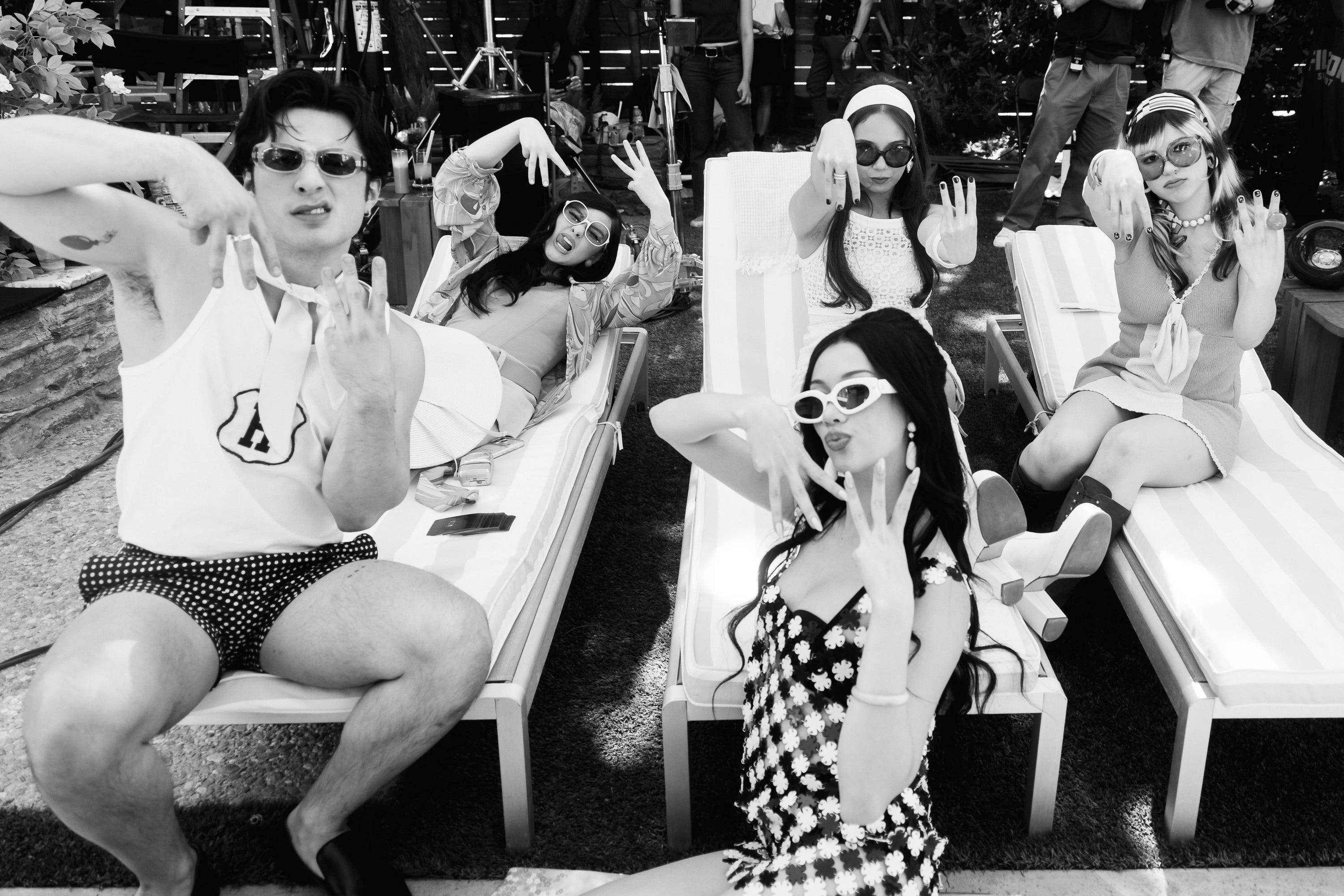
So, as trivial as it may seem, seeing Laufey, Alysa, Hudson, Lola, and Megan side by side in the Madwoman music video means something to me and a lot of other mixed people. It’s not perfect, no representation ever is, but it’s a start.
As for its imperfections, I have a few thoughts on those, too. The sentiment of wanting to put a cast of mixed Asians in a historical setting where we might not expect to see them, to essentially turn them into an anachronism, is well-intentioned but it erases the fact that mixed people, even mixed Asians, have always existed throughout history. Watching the video, I kept thinking how much Laufey, especially when she puts on a cheongsam, resembles Nancy Kwan in films like The World of Suzie Wong and Flower Drum Song. Yet, as far as I can tell, Laufey never mentions Kwan as a reference or inspiration. Does she even know who Nancy Kwan is?
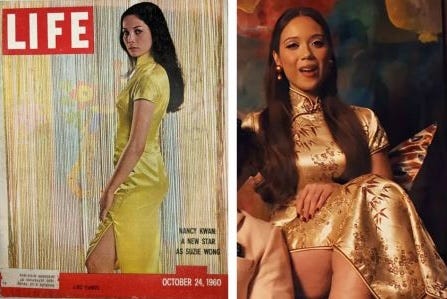
Of course, there were others before Kwan, too, like Etta Lee, an early silent film player I’ve written about previously. And there have been others since: Bruce Lee, Jennifer Tilly, Tiger Woods, Kristin Kreuk, Keanu Reeves, Kimora Lee Simmons, Dean Cain, Olivia Munn, Bruno Mars, etc. Maybe there weren’t enough of us to populate an entire film in prior decades (the laws of this country were designed so that mixed people wouldn’t exist in the first place), but we’ve always been here. By the way, if you want to see a story about Asians set in the 1960s, all you have to do is watch Wong Kar Wai’s languorous masterpiece In the Mood for Love. But maybe this ahistoricism can be chalked up to Gen Z’s general lack of awareness of who and what came before them.
The more problematic aspect of the video is that it only features a select type of mixed Asian people: Wasians. I’ve used the terms hapa and mixed Asian somewhat interchangeably in this piece. I prefer to identify as Asian American, hapa, or mixed (Asian). I’m showing my age by saying this, but my generation has always looked upon the word “Wasian”—a portmanteau for white and Asian—as a joke. I would never seriously call myself that, though I’ve always been envious of those who could call themselves “Blasian,” Wasian’s much cooler counterpart. Well, kids these days, they actually call themselves Wasian with a straight face. But here’s the rub. The terms Wasian and Blasian reinforce the black/white binary that already divides and stratifies race in America as two opposite poles. It segregates mixed people from themselves. As if we needed more factions or fractions.
In contrast, the Native Hawaiian word “hapa” means half or part. It was initially used by Native Hawaiians to refer to the mixed offspring of locals and foreigners, who they called hapa haole or half white. Somewhere along the way, as words often do, the term migrated to California and expanded to refer to anyone of mixed Asian or Pacific Islander heritage. Kip Fulbeck’s groundbreaking photography has been documenting people who claim this identity through The Hapa Project for the last 25 years. More recently, some have complained that using a Hawaiian word to identify ourselves is the bad sort of appropriation. I disagree. I won’t get into all the reasons why here, but suffice it to say that hapa is a much more open-ended term and more importantly, it doesn’t center whiteness.
Because Madwoman celebrates a specific subset of mixed Asian people—those who are part white and Asian—intentionally or not, it promotes and idealizes an image of mixed Asians. On the one hand, this is a good thing. More people need to know what we look like. On the other hand, not everyone fits this mold. Mixed people are as diverse as the people who made us. And we aren’t all part white. Some of us are not white at all. Like Autumn Durald Arkapaw, who is Filipino and Black Creole and recently made history when she became the first woman to win an Academy Award for Cinematography for her work on Sinners. There are plenty of mixed Asians who are also part Black, Latino, Native, Middle Eastern, etc. Again, this is an issue of narrative scarcity. No work can represent the true diversity of the mixed experience, but it’s at least worth trying. Madwoman doesn’t leave room for other types of mixed Asians and I wonder how people who identify with those “alternative” mixes have reacted to this music video. Do you feel left out? Invisible? Like an overlooked minority of an already small minority? Or are you happy to see your fellow mixed Asians (Wasian or not) paving the way for more barriers to be broken?

Just as I was finishing writing this dispatch, I was invited to a meetup in Central Park that was advertised as a “Wasian gathering” with the appeal, “let’s make this the largest convening of wasians in NYC <3.” As of this afternoon, 3,634 people had rsvped and 1,284 were maybes. The invitation flyer featured the gang from Madwoman, a couple of people I’m not familiar with, and Joseph Gordon-Levitt who is no part Asian. Was this an insider’s joke (takes a hapa to know a hapa) or merely another way in which Gen Z is showing its youthful ignorance? The Madwoman video’s popularity has apparently inspired a wave of Wasian meetups in major cities across the country. The NYC meetup included a Wasian celebrity lookalike contest. TikTok influencers have started celebrating the country of Wasia, what some claim is their imagined homeland, with slideshows of its most famous citizens. Another influencer announced that she is now accepting citizenship applications for the Kingdom of Wasia (aka a private discord chat).
Regrettably, the term Wasian is likely here to stay. That said, I do believe that everyone has the right to define their identity and decide what to call themselves—even if it makes me cringe. We all want to see ourselves reflected in the world we inhabit, to feel acknowledged, like we belong and have a respected place in this society. But why does the urge to do so often come at the expense of excluding someone else? I don’t have an answer for this conundrum but I’d love to hear yours in the comments.
Updates in Brief
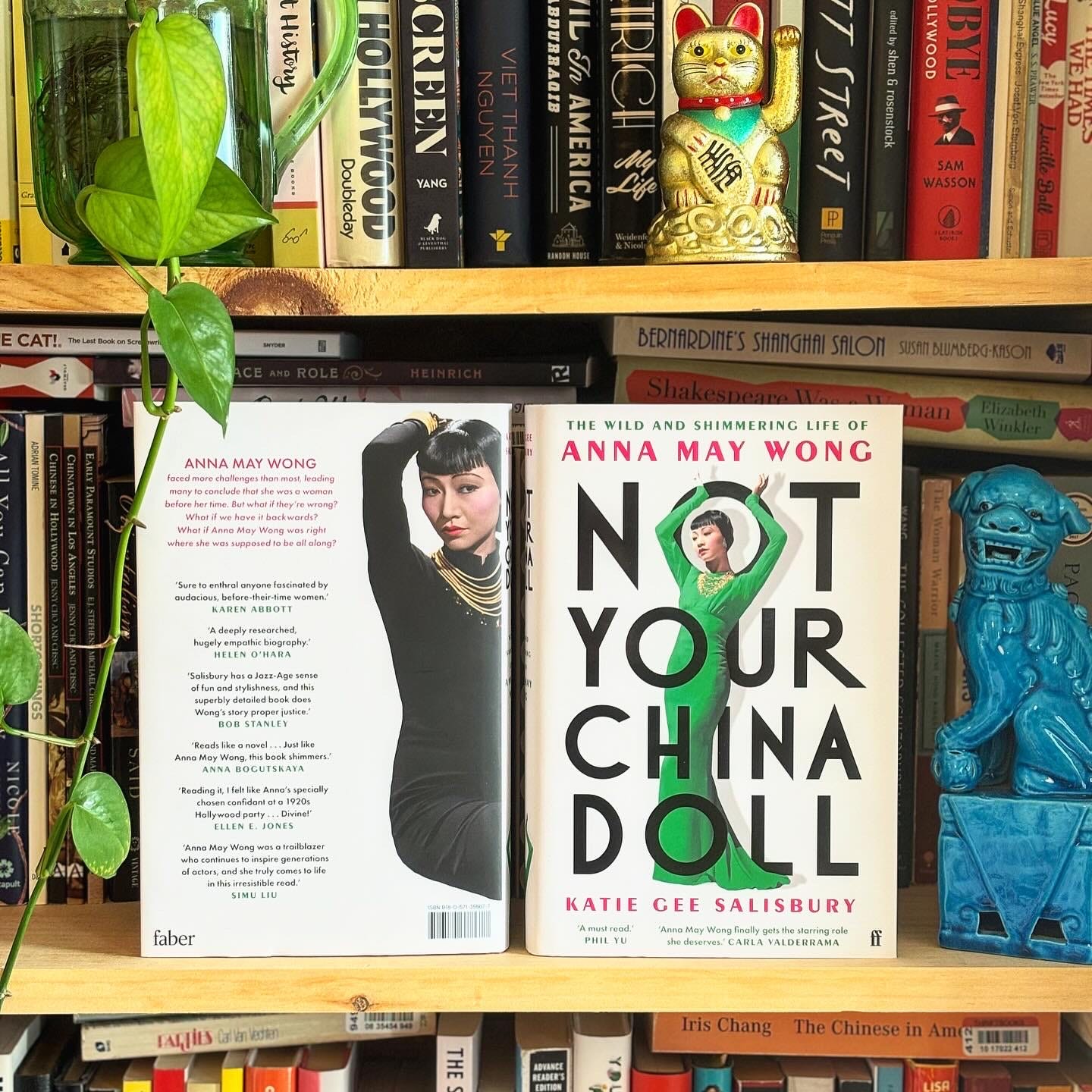
May is Asian American and Pacific Islander Heritage Month! To celebrate and get some spring cleaning done at the same time, I’m doing a book giveaway for subscribers. I have a few signed hardcover and paperback copies of the UK edition of Not Your China Doll to give away as well as a signed copy of Jeff Yang’s book The Golden Screen. To enter, make sure you’re subscribed to Half-Caste Woman and then reply to this email (or in the comments) by next Sunday, May 17, with “Enter me in the book giveaway!”
AANHPI Heritage Month is also a great time to pick up a set of #StarringAnnaMayWong postcards or a copy of my photography zine American Dreams in a Chinese Takeout, a project that highlights the lives of Chinese restaurant workers in New York. And speaking of heritage months, I was delighted to see that PEN America selected Not Your China Doll as one of its picks for Women’s History Month back in March.
If you live on Long Island, I’ll be hosting a screening of Song, the first film Anna May Wong made when she went to Germany in 1928 (and my favorite of her films), at the Cinema Arts Centre in Huntington on May 28 with musical accompaniment by the talented Ben Model. Get tickets here.
There are quite a lot of high profile blasian athletes and musicians but I noticed that they are embraced by the Black community and referred to as Black most of the time, if not all of the time.
e.g. the singer H.E.R, Anderson Paak, Jhene Aiko, Tyga etc. Like they are very much what we call "Black famous" (ppl famous within the Black community but might not be that famous with the general public).
I have never heard these people be embraced by other Asians, esp Western ones who seek Asian representation. Most Asians aren't even aware these people are Asian if they do know them.
Even the athletes like Naomi Osaka (tennis), Rui Hachimura (nba), Zion Suzuki (Japan National soccer team), Jordan Clarkson (nba) and Jalen Green (nba) are only acknowledged as part Asian when they represent an Asian national team but that's not necessary for Wasian athletes/celebrities to do. I won't add Tiger Woods because I don't think he likes to talk about his Asianness at all, though everyone is aware of it, he's still seen as Black.
I kinda get why because my guess is Wasians have a paler complexion and fit the "Asian look" whereas Blasians completely defy it. At the end of the day, I don't blame Blasians for going where they are more embraced.
Part of that embrace of Blasians does come from internalised racism and colorism as Blasians tend to be lighter and have "less Black" features so some Black people desire to claim them for that reason.
It's the opposite for full Asians as they are unwilling to claim Blasians due to them being part Black but desire & worship Wasians due to them being Whiter so I guess everyone is aspiring to be Whiter. In conclusion, colonialism is still alive.
I'd not heard the term 'Wasian' before. Growing up half-Chinese in mid '60s New Jersey was not comfortable, since there was no awareness that being half was any sort of an option. But now it's pretty commonplace.
I contributed a little bit to the Hapa Project, and I tell everyone mixed that they're welcome to use my standard joke. "I'm half-Chinese. In school I got straight Bs" That was literally true, but it was decades later that I realized that it was also hilarious...